
Amazon now wants to control your account with AI.
And it's not a suggestion.
Last September I wrote about Virtual Multipacks and I was pumped. Amazon takes a single-pack listing you already have and builds the 2-pack and the 3-pack off it. No bundling, no labels, no new inventory, nothing for you to do. Sellers had been asking for it for years. When I came back to the program in January, I summed it up in two words: everyone wins.
I still think that's mostly right.
Because here's what the program actually does, and I published most of it myself at the time under a heading I called "Gotchas." Amazon's selection process picks which of your listings get a multipack, and there is no option to manually join or opt into the pilot. Amazon builds the image from your single-pack photos, and it won't update if you change your originals. The default price is your unit price times the pack size. Delete one during the pilot and you can't reactivate it.
Think about that: A product I didn't create, imaged by Amazon, priced by Amazon, sitting on my brand.
And it isn't one program. These are all live right now:
- Titles over 75 characters get rewritten by Amazon's AI over time, not chopped off. Brand owners got a short window to review before Amazon pushed them live. If someone put a gun to my head and told me to guess how many people stuck with Amazon's AI titles and didn't change anything, I'd say >80%.
- The same tool drafts edits to the rest of your page using "data from Amazon's catalog and your brand website." Then this, from an Amazon moderator on Amazon's own forum: "You have 14 days to review and respond. If no feedback is provided within this window, the proposed changes will automatically be applied to your product detail pages."
- From August 10, 2026, Sponsored Products started serving inside Amazon Influencer content. Existing campaigns were swept in at their current bids and budgets, and advertisers didn't have to take any action to be included.
- "Customers say," the AI paragraph at the top of your reviews, is the most-read copy on your listing. Amazon also runs "Hear the highlights", AI hosts talking through your product out loud, and shoppers can now interrupt and ask them questions. You wrote none of it.
- Sellers heavily optimize their product attributes or categories (like material or size) for ranking. Amazon's AI frequently overwrites these with what it thinks is better, changing the context entirely.
And on and on.
Your listing is a shared document & Amazon has the edit rights
And yet, I can't argue with much of it. I run my own account this way on purpose. Claude Code touches my listings, my PPC runs on rules I half-wrote. I'm not the guy who wants a human in every loop. I just noticed that I stopped being the one who decides which loops exist.
Let's look at it from their side
Amazon suffers a bad listing right along with you. A title written for a keyword robot instead of a shopper costs them the sale too. They published best practices for over 10 years and asked nicely. And when Amazon does ask, we say yes. Amazon says more than 900,000 selling partners have used its AI listing tools, and that sellers accept what the AI writes with little to no edits about 90% of the time. Click, accept, next. When 9 out of 10 say yes, the asking is the only slow part left.
Dharmesh Mehta, then Amazon's VP of Worldwide Selling Partner Services, put it on Amazon's own website in May 2025: "We can automatically generate product listings, images, videos, and creative campaigns on a seller's behalf." On a seller's behalf. That's the new normal.
Marketplace Pulse estimates active Amazon.com sellers fell from 584,000 in January 2025 to 500,000 in March 2026. Amazon can't grow their biggest store by adding sellers anymore. It has to grow by getting more out of the listings it already has, and most of those belong to somebody who hasn't completed every recommended change. On the October 2025 earnings call, CEO Andy Jassy told investors that Rufus, its AI shopping assistant, was "on track to deliver over $10 billion in incremental annualized sales."
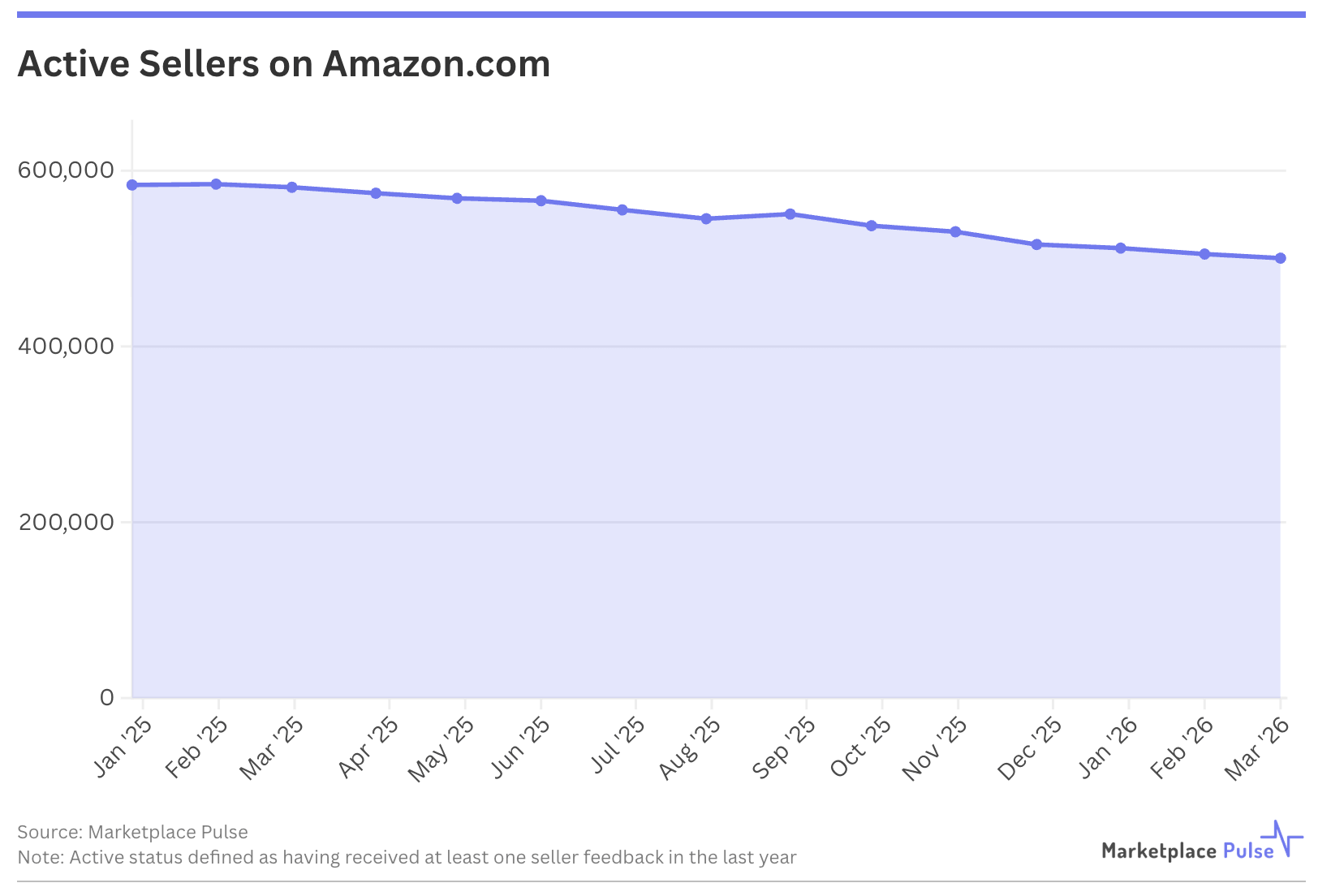
Active sellers on Amazon.com, January 2025 to March 2026. Source: Marketplace Pulse.
Yes, all of it can be rolled back. Delete the multipack before it goes live, reject the title, change the category back, etc. That's real, and it's the first thing people say when I bring this up. So call it what it is. Not a seizure, a change in who has to act. Amazon used to need your yes. Now it needs your no, on a deadline, per feature, in a tab you have to remember exists.
It isn't only Amazon
Mark Zuckerberg said it out loud in May 2025: "you tell us what your objective is, you connect to your bank account, you don't need any creative, you don't need any targeting demographic, you don't need any measurement, except to be able to read the results that we spit out." They don't want individual ad buyers running their own ads because humans are messy, inconsistent, and the vast majority would not be as good as AI at running them.
On Amazon, the AI will win against most existing content. Not against you, obviously. ;) You read this stuff on purpose. But against a title nobody has touched since 2022? Against a listing with four attributes filled out of thirty? It isn't close.
Which is the part I keep thinking about: Amazon isn't coming for my listing. It's coming for my advantage. For over 10 years a real chunk of my edge was just doing the boring work most sellers didn't do well. Amazon is doing that work for them now, for free.
So go look. Manage All Inventory, search "VMP_". Then open Review Listing Changes and see what's sitting in there. For 20 years Amazon enforced your listing's content. Now it writes it. That's the future: Amazon won't allow us to manually make listing changes without approval. We'll all be uploading a single image of our products and the AI will do the rest.
We cover what Amazon just changed and what it actually costs you, written by sellers running real accounts. Join the newsletter.