First published in Selling From the Beach on November 9, 2026.
The short version
Don't bid the most you'd ever pay. Bid what a click is actually worth to you.
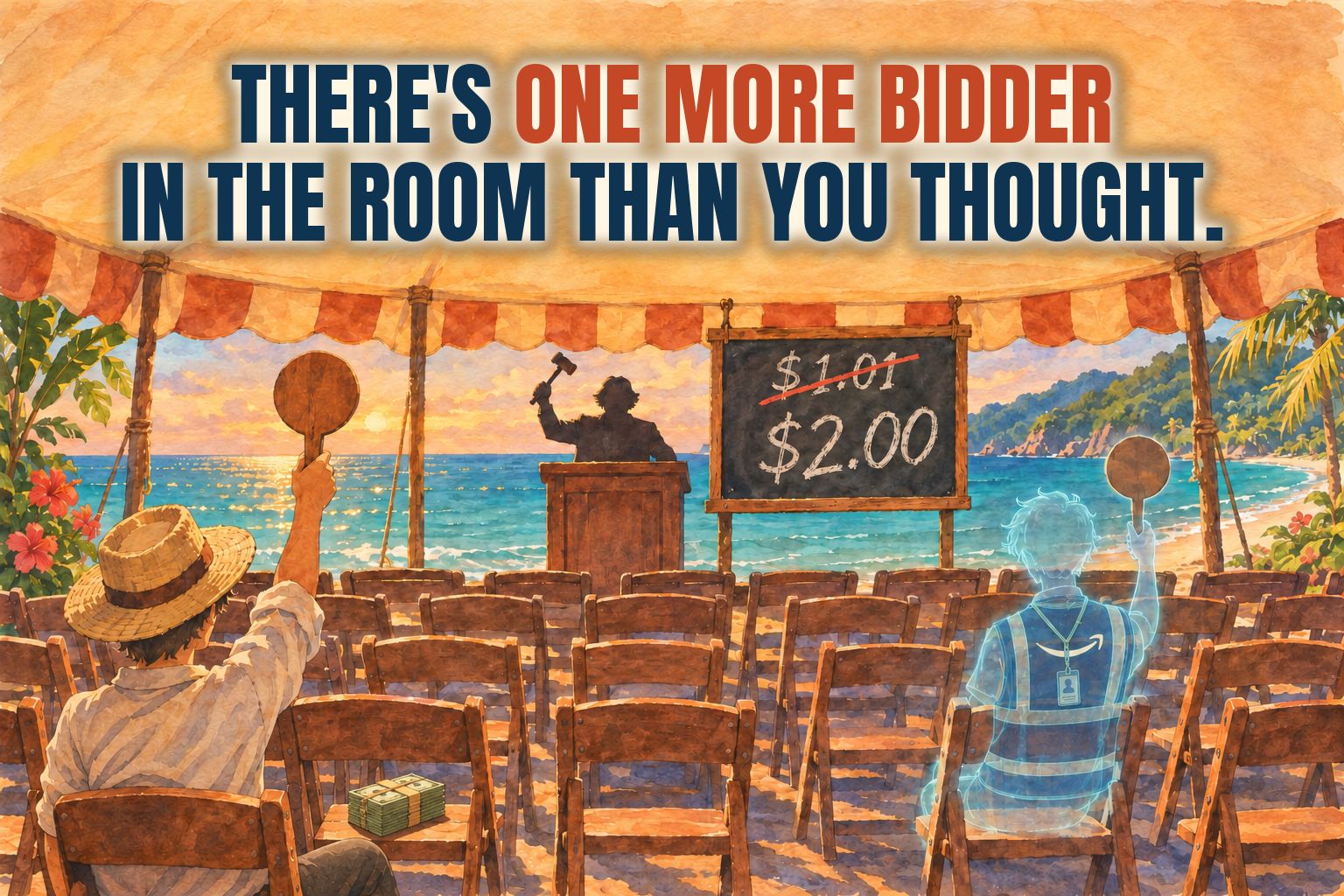
In 1990, the New Zealand government auctioned off licenses to broadcast TV (A license was just permission to use one channel on the dial). No studio, no equipment, no shows. The winner had to build all that themselves.
The auction had one odd rule. Everyone sends in one secret bid, and the highest bid wins. But the winner doesn't pay their own bid. They pay the runner-up's bid.
On one license, the top bid was $100,000. The runner-up bid $6. So the winner paid $6. The government could have had $100,000. It got $6. The next year, it changed the rules.
That rule wasn't actually dumb. It means nobody has to guess what to bid. If you pay the next guy's price instead of your own, you can just write down the most it's worth to you, and you'll never pay more than you have to.
That's the same deal Amazon says it gives us on ads. Say you bid $2 on a keyword and the next seller bid $1. Amazon has always said you win, and you pay $1.01. One cent more than the next guy.
Most of us believed it. I did. So we set our bids high. Your bid is just the most you'd ever pay, and the auction finds the real price, which is usually lower.
In August, the FTC (the US government agency that goes after unfair business practices) and 22 states sued Amazon. On November 5, 2026, they made more of their evidence public. They say Amazon runs the auction like normal, then quietly bumps the price up. In our example, instead of paying $1.01, you pay more. Often the full $2.
Here are their numbers for Sponsored Products. In 2021, sellers paid their full bid 30% to 40% of the time. By 2024, it was about 80% of the time. On big days like Prime Day and Black Friday, prices went as high as 250% above what the auction said they should be.
The point: there's one more bidder in the room than you thought (It’s you know who.)
When one advertiser asked Amazon if something had changed, an Amazon rep wrote back "there is not a bug... so no worries there," and blamed more competition. Amazon calls the lawsuit "misguided." None of it has been proven in court yet.
But if the FTC is right, your bid isn't the most you'll pay. Most of the time, it's what you pay.
That changes how you should bid. Don't bid the most you'd ever pay. Bid what a click is actually worth to you.
The math is quick: your price, times your profit margin before ads, times your conversion rate. A $25 product with a 30% margin, where 1 in 10 clicks buys, is worth 75 cents a click. That's break-even. If you're bidding $1.40 on that keyword because "I'll only pay what I have to," you're probably paying close to $1.40, and every sale from that click loses you money.
Black Friday is November 27. It's one of the days the FTC says prices got marked up as much as 250%. Before then, go through your top keywords and bring every bid down to what a click is worth to you.
Stay safe out there.
What did the FTC say about Amazon ad prices on November 5, 2026?
The FTC's November 5, 2026 release says the unredacted parts of the complaint allege Amazon secretly raises advertising prices by as much as 50% above auction results on ordinary days and by as much as 250% on major shopping days like Prime Day or Black Friday.
For the 2021 holiday season, the complaint alleges Amazon increased advertisers' average cost-per-click by 20%, with some advertisers seeing increases of over 200%.
For the 2022 holiday shopping season, the complaint alleges the surcharges raised Amazon's revenue by $87 million worldwide.
Why does the type of auction change how an Amazon advertiser bids?
In a second-price auction, bidders are more likely to bid higher, closer to their true value for the product, because they will only be liable to pay the least bid amount needed to win.
In a first-price auction, winners pay the amount of their winning bid, so in repeated auctions for the same thing, bidders often lower their bid to find the minimum amount needed to win.
After the $6 payment, New Zealand switched to a first-price auction in 1991.
The August complaint quotes Amazon employees saying that advertisers "believe Amazon will not simply charge their first price".
Does paying your full bid lose money on a $25 product?
Yes, in this example: at a $1.40 bid charged in full on every click, the $25 product above loses $6.50 on each sale.
| Step | Math | Result |
|---|---|---|
| Profit per sale before ads | 25 x 30% | $7.50 |
| Break-even bid per click | 7.50 x 1 in 10 clicks buys | $0.75 |
| Ad cost per sale at $1.40 a click | 1.40 x 10 clicks | $14.00 |
| Result per sale | 7.50 minus 14.00 | $6.50 loss |
What are Sponsored Products ads?
Sponsored Products are ads that advertisers bid to place alongside the results that appear when a shopper searches for a product using a keyword on Amazon's store.
When does the FTC say the Amazon ads surcharge started?
The August complaint alleges that beginning in 2019, Amazon changed its auction rules without notice by adding an undisclosed surcharge that Amazon referred to internally as a "soft reserve price".
Another document quoted in the complaint says Amazon uses an "invented auction participant" to increase prices.