
First published in Selling From the Beach on October 5, 2026.
The short version
Put two in the box and you pay one fee instead of two. The money you save can come off the price per item, and you still make more on every sale than you did on the single.
What does a per-unit fee do to a cheap product?
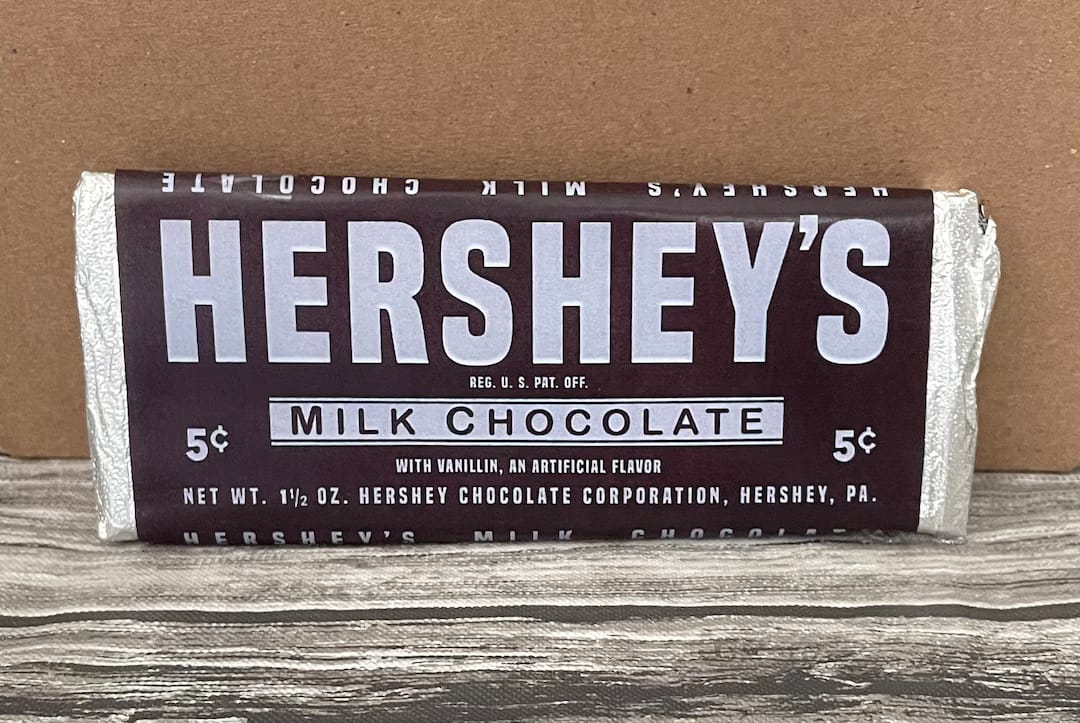
For almost 70 years, a Hershey bar cost a nickel.
Hershey started selling it for five cents in 1900, and the price stuck. When cocoa got expensive, Hershey didn't raise it. They made the bar smaller. When cocoa got cheap, the bar got bigger again. The nickel never moved.
By the late 1960s the nickel bar was under an ounce. There wasn't much bar left to shrink.
On November 24, 1969, Hershey finally gave up the nickel. What they did next is the part I keep thinking about because I'm stuck in my own version of this right now.
In September 2026, Amazon re-measured one of my products in Canada, and the fee to ship it went from $5.94 to $9.79. The product sold for $9.99. Add the referral fee and I was losing money on every one.
That fee is charged per unit. It's the same whether the box holds a little or a lot, so a single cheap product has to carry the whole thing by itself. My product was a shrunken nickel bar. The fee had eaten the whole price. No bueno.
What should I do? Well… here's what Hershey did. They doubled the price to a dime, and they made the bar more than twice as big. Customers paid twice as much and got more than twice the chocolate. Hershey raised its price and gave people a better deal on the same day.
That works whenever part of your cost doesn't care how big the product is. On Amazon, that's the fulfillment fee. Put two in the box and you pay one fee instead of two. The money you save can come off the price per item, and you still make more on every sale than you did on the single.
For a cheap product, the single is the worst deal on Amazon. Worst for you, and worst for your customer.
Yeah, we could just raise the price. But maybe we should be making the box bigger.
Are Amazon FBA bundles and multipacks cheaper? The fee math for a single vs a 2-pack
Amazon describes the FBA fulfillment fee as a flat fee per unit, based on the size and weight of the product. If an FBA product is sold as a set, the weight and dimensions used are those of the set packaged together. So a pack shipped as one unit pays one fee; two separate units pay two.
Amazon also has virtual versions. In Amazon's terms, virtual multipacks contain multiple units of the same ASIN, and bundles combine different ASINs. Neither gets that one-fee saving. Amazon fulfills a virtual multipack from your single-pack inventory, and a 2-pack virtual multipack is charged 2 times the single-pack fulfillment fee. The products in a virtual bundle are fulfilled and shipped individually, and are charged the same seller fees as if they were purchased individually.
Amazon's product bundling policy treats these as different things: bundles don't include multi-packs, which consist of two or more identical products. A physical bundle of different products is only allowed if it was packaged by the original manufacturer or brand, with a few exceptions such as a letter of authorization from every brand in it.
The math uses Amazon's holiday peak rate card for US non-apparel products, which runs from October 15, 2026 to January 14, 2027. All dollar figures below are US dollars.
Here's a made-up product, sold as a single and as a 2-pack. Profit here is before storage, inbound placement, returns and ads.
| Sample product | Single | 2-pack |
|---|---|---|
| Packed size and unit weight | 7 x 5 x 0.3 in, 4.5 oz | 7 x 5 x 0.65 in, 9.5 oz |
| Size tier | Small standard | Small standard |
| Price | $9.49 | $17.99 |
| Product cost delivered to Amazon | $3.90 | $8.10 (2 x $3.90 plus $0.30 box) |
| Referral fee, 15% of price | $1.42 | $2.70 |
| FBA fulfillment fee from the rate card | $2.76 (4+ to 6 oz, under $10 rate) | $3.89 (8+ to 10 oz, $10 to $50 rate) |
| Fuel and logistics surcharge, 3.5% of the fulfillment fee | $0.10 | $0.14 |
| Profit per unit sold | $1.31 | $3.16 |
| Profit on two items | $2.62 (2 x $1.31) | $3.16 |
| What the customer pays for two items | $18.98 (2 x $9.49) | $17.99 |
Sold as two singles, the same two items earn $2.62. Sold as one 2-pack, they earn $3.16, which is $0.54 more, and the customer pays $0.99 less.
What changes the answer?
- Thickness. Small standard ends at 0.75 inches on the shortest side. Packed 0.8 inches thick, the 2-pack becomes Large standard, which bills the greater of unit weight and dimensional weight. The 9.5 oz unit weight is the larger of the two, so the fee is $4.48. Profit per unit sold is $2.55, $0.07 below two singles.
- Referral fee jumps. In Amazon's Beauty, Health, and Personal Care and Baby Products categories, the referral fee is 8% when the total price is $10.00 or less and 15% when it is more. In Grocery and Gourmet the line is $15.00. In each, the single pays $0.76 and earns $1.97, so two singles earn $3.94 against $3.16 for the 2-pack.
How do you find the bundle or multipack your customers already buy?
Amazon's All Orders report covers both FBA and seller-fulfilled orders and lists each item's order ID, SKU and quantity. Rows with the same order ID were one order. A quantity of 2 or more means that order held two or more of the item.
I ran my All Orders report through a simple tool I spun up. Here's what it reads:
- Which of your products keep landing in the same cart. The pairs your customers already bundle themselves, one order at a time.
- Which single products people buy two and three at a time. That second list is the one that matters. Every item on it is a multipack begging to exist.
I've been at this long enough to be suspicious of "easy SKU" anything. Most of the time the easiest launch is a plastic widget that dies in 90 days. This is different. A 2-pack of a product you ALREADY sell, to customers who are ALREADY buying it two at a time, is not really a launch. It's just noticing that you already have something to sell!