
First published in Selling From the Beach on March 23, 2026.
The short version: if Claude Code tells you it's weak in an area... just ask it to get good at it.
What do you do when Claude Code does what you ask but the work looks bad?
You know that scene in The Matrix. Neo gets plugged in, closes his eyes... and three seconds later opens them and says "I know Kung Fu."
That's exactly what happened when I was working on my brand website with Claude Code.
It was doing what I asked. Following instructions, making changes, ticking boxes. But the design was ugly. I'm sitting there thinking… yes you’re literally doing what I’m asking for but it is pretty tough to look at. Like comic sans on a funeral program.
So I just asked it straight. "Why isn't this looking better?"
It told me it was working inside the MoveDo/Groove theme framework (my website’s theme)… and that it didn't have deep expertise in designing with those specific docs.
So I pushed it. "Could you learn it? Like, actually go deep and become the best MoveDo/Groove designer in the world?"
It said yes.
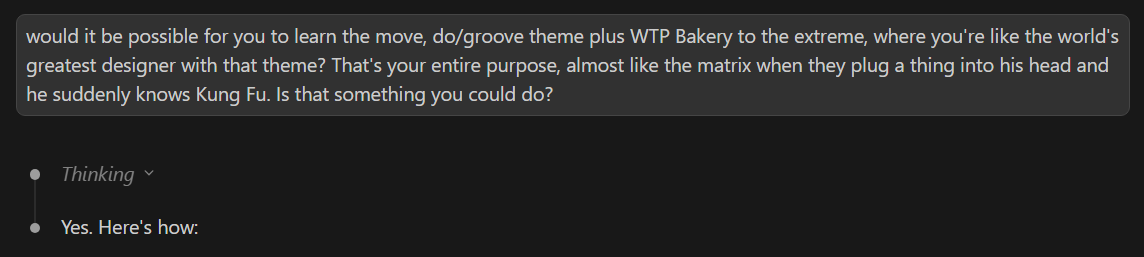
Then it went away and did its thing for about 10 minutes. Came back. The design was noticeably better. It had gone off, absorbed the docs, and levelled up in real time.
Just like Neo.
The brainwave for me was this: if Claude Code tells you it's weak in an area... just ask it to get good at it. You might be surprised what happens when you plug it in.
How do you get Claude Code to learn a new subject?
Claude Code is Anthropic’s coding tool that reads your files, edits them and runs commands.
Anthropic’s best practices say Claude is effective at learning command-line tools it doesn’t already know. Their example prompt tells Claude to read a tool’s help output to learn it, then use the tool to solve your tasks.
The same guide says you can provide rich data to Claude in several ways:
- Give it URLs for documentation.
- Point it at files with @ instead of describing where things live. Claude reads the file before responding.
- Let it fetch what it needs: tell it to pull context itself by running commands, using connected tools or reading files.
As of October 2026, each Claude Code session begins with a fresh context window. Anthropic names two things that carry knowledge across sessions: CLAUDE.md files, which you write in plain text, and auto memory, which is notes Claude writes itself from your corrections and preferences.
Anthropic’s guide explains the context window this way: it holds your entire conversation, including every message, every file Claude reads, and every command output, and performance degrades as context fills. When a session nears its limit, Claude Code automatically compacts the conversation history, which preserves important code and decisions while freeing space.
Anthropic’s guide also describes skills: SKILL.md files in .claude/skills/ that give Claude domain knowledge and reusable workflows. Claude applies them automatically when relevant, or you can invoke one directly with /skill-name.
Should you keep one long prompt for a job you repeat?
A friend of mine has a daily Amazon task he runs through Claude. He'd built a careful prompt over months that orchestrated what he wanted to do.
One morning he forgot. Typed what he wanted in one sentence. Got the best output he'd ever seen. WTF?
He’d been the slow part the whole time.
This is going to compound with every model release, as the gap between scripted prompts and outcome will continue to widen. The seller who locked in a workflow eighteen months ago is frozen at eighteen-months-ago quality.
If you have a structured prompt you’ve been using for a long time it’s going to give you weaker results. Crazy.
At this point we’ve seen how fast the AI models ship stuff (weekly? daily?). But this seems pretty clear: Eventually, prompt engineering goes the way of "knowing how to look things up." The skill collapses. What replaces it is the only thing the agent can't do: know what you actually want.
Today, the moat is still operational. Whoever has the cleanest SOP, the tightest PPC structure, or the best supplier relationships wins.
In the near future, the moat will be taste.
Taste is brand clarity. Taste is knowing what an on-brand listing looks like, what a wrong-feeling product would be, who exactly you're for. If you can articulate that, the agent builds everything around it. If you can't, the agent gives you the same generic output it gives every other seller, and everyone converges somewhere in the middle.
In the near future, we won’t be telling agents how to do their work. We’ll be telling them what good work looks like. Outcomes, not processes.
Here’s a guess: The brands that win the next decade are the ones whose founders can finish the sentence "we are the brand of ___." The ones who can't will run great agents, get average results, and never understand why.
What does Anthropic say about prompt detail?
Anthropic’s Claude Code guide says you describe what you want and Claude figures out how to build it.
In its section Provide specific context in your prompts, the guide says the more precise your instructions, the fewer corrections you’ll need, and Claude can infer intent, but it can’t read your mind. For a bug, it suggests you provide the symptom, the likely location, and what “fixed” looks like.
Anthropic’s September 29, 2025 engineering post says smarter models require less prescriptive engineering. It describes engineers hardcoding complex, brittle logic in their prompts, an approach that creates fragility and increases maintenance complexity over time. Its advice: start by testing a minimal prompt with the best model available to see how it performs on your task, and then add clear instructions and examples to improve performance based on failure modes found during initial testing.
More Claude Code tips for beginners, from Anthropic’s guide
- Give Claude a check it can run: tests, a build, a screenshot to compare. For a design, Anthropic’s example prompt is: “implement this design. take a screenshot of the result and compare it to the original. list differences and fix them.”
- For larger features, have Claude interview you first.
- Plan mode lets Claude read files and answer questions without making changes. Anthropic’s reason: letting Claude jump straight to coding can produce code that solves the wrong problem.
- To keep research out of your main conversation, ask Claude to use subagents to investigate. They explore in a separate context.
- Correct Claude as soon as you notice it going off track. If you have corrected it more than twice on the same issue in one session, run /clear and start fresh with a more specific prompt.
- Run /clear between unrelated tasks to reset context.
- Run /init to generate a starter CLAUDE.md file based on your current project structure. Then run /context to confirm Claude loaded the file.
Do you need to code to use Claude Code?
No. Anthropic’s terminal guide says “You don’t need to know how to code. Describe what you want in plain English, and Claude writes the code for you.” As of October 2026, the Claude Code desktop app lets you skip the terminal entirely, and a paid subscription is required.
Keep reading
- How To Build A SOP (And Stop Doing Absolutely Everything). SOP stands for standard operating procedure.
- Amazon AI Listing Changes: You Now Have to Opt Out
- More Amazon guides from Selling From the Beach