
If you want to win on Amazon, you need to master the Buy Box. It all boils down to excelling in four key areas: sharp pricing, lightning-fast fulfillment (ideally FBA), spotless seller metrics, and always having products in stock. When you get these right, you're signaling to Amazon that your offer gives customers the best possible experience, making you their top pick.
Why the Buy Box Is Your Most Important Asset
For any seller on Amazon, the Buy Box isn't just some feature to know about—it's the absolute heart of your sales strategy. We're talking about the prime real estate on a product page where the "Add to Cart" and "Buy Now" buttons live. It's the express lane for shoppers. When a customer clicks either of those buttons, the sale goes to the one seller who "owns" the Buy Box at that exact moment.
The effect this has on your revenue is massive. The Buy Box is responsible for over 82% of all sales on Amazon. If your offer isn't the one featured, you're left fighting over the scraps. We've seen product sales crash by 90% or more overnight simply from losing the Buy Box. That's a potential death blow for any business trying to grow. These stats are widely cited for a reason, often discussed by platforms like Repricer.com, because they underscore just how critical this one feature is.
First Things First: Are You Even Eligible for the Buy Box?
Before you can even dream of winning the Buy Box, you have to be eligible. Amazon’s algorithm won't even look at your offer if you don't meet a few basic requirements. Think of it as a gatekeeping system designed to make sure only serious, reliable sellers get a shot at this prime placement.
Not meeting these criteria means you're not even in the game. It's the absolute baseline.
Quick Buy Box Eligibility Checklist
Here’s a quick-glance table to see if your account has what it takes to start competing.
| Requirement | What It Means for Your Account | How to Check Your Status |
|---|---|---|
| Professional Seller Account | You must be on the paid monthly plan, not the free Individual one. | Go to Settings > Account Info > Your Services in Seller Central. |
| Buy Box Eligible Status | Your specific product (ASIN) must be eligible. This is earned over time. | In Seller Central, go to Manage Inventory and add the "Buy Box Eligible" column. |
| Item Condition | The item must be listed as "New." Used items compete for a separate Used Buy Box. | Check the "Condition" field on your listing in Manage Inventory. |
| Available Inventory | You must have the item in stock and ready to ship. | Your "Available" quantity in Manage Inventory must be greater than zero. |
If you're checking all these boxes, you're ready to start competing. If not, this is your first priority.
Amazon's entire focus is on creating a smooth, trustworthy experience for buyers. Meeting these initial requirements is just your way of telling the algorithm, "I'm a legitimate seller you can count on."
The Unfair Advantage of FBA
While it's technically possible to win the Buy Box without it, using Fulfillment by Amazon (FBA) is like getting a backstage pass. When you enroll in FBA, you send your products to Amazon's fulfillment centers, and they take over the heavy lifting—storage, picking, packing, shipping, and even customer service.
This gives you a huge, immediate leg up in the Buy Box algorithm. Why? Because FBA automatically checks off two of the most important boxes for Amazon: Prime eligibility and perfect shipping metrics. Your products are instantly available for free two-day shipping for Prime members, which is a massive driver for conversions. You have to protect your assets, and using FBA is a core part of that strategy. You can find a detailed guide on how to win the Amazon Buy Box that dives deeper into these tactics.
For anyone running a location-independent business, FBA is a complete game-changer. It automates the most grueling parts of e-commerce, letting you focus on sourcing products and marketing your brand from anywhere in the world—not running a warehouse. This is how you turn your business from a daily grind into a scalable asset that works for you. Today, we protect our absolute number one asset by making smart, strategic decisions like this.
Decoding the Core Buy Box Ranking Factors
So, you’ve met the basic requirements and are officially in the running for the Buy Box. This is where the real work begins. Amazon's algorithm is constantly crunching the numbers on dozens of variables to determine which seller gives the customer the best possible experience. Winning isn't just about having the lowest price; it's about proving you're the most reliable, efficient, and customer-focused seller for that specific product.
While Amazon keeps its exact formula under wraps, years of selling on the platform have made the hierarchy of ranking factors pretty clear. If you want to consistently win the Buy Box, you need to master the three pillars that carry the most weight: your fulfillment method, your landed price, and your shipping time.
Before we dive into winning the rotation, though, let's remember the absolute must-haves for even being considered.
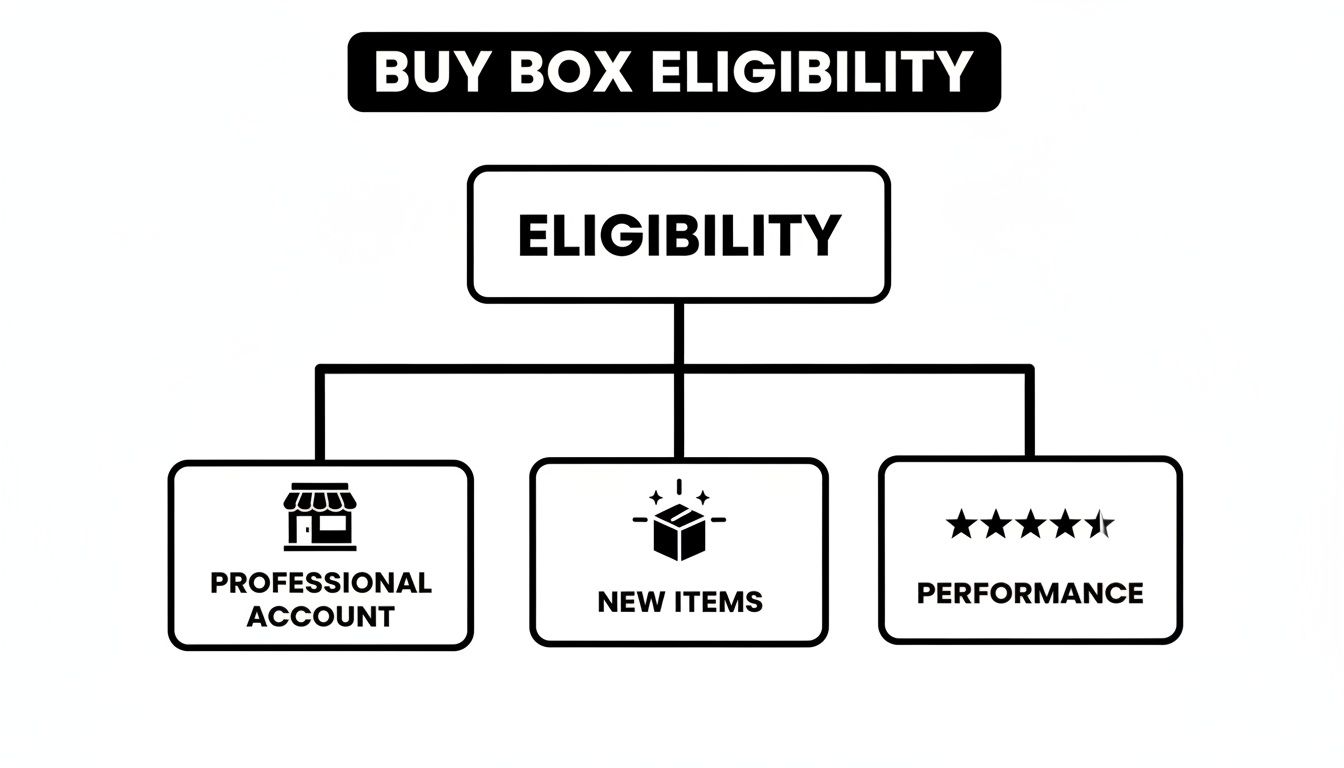
Think of these three elements—a Professional Account, selling new items, and maintaining solid performance metrics—as your non-negotiable ticket to the game. Without them, you're not even on the field.
The Decisive Power of Your Fulfillment Method
Make no mistake: the single most powerful variable in the Buy Box equation is how you fulfill your orders. Amazon gives a massive advantage to sellers using Fulfillment by Amazon (FBA). When you enroll in FBA, you’re essentially tapping into Amazon's own legendary logistics network, and in the algorithm's eyes, you're borrowing its credibility.
This gives you an immediate, almost unfair, advantage in two ways:
- Automatic Prime Eligibility: Your products instantly qualify for the free, fast shipping that millions of Prime members expect. This is a huge conversion booster, and Amazon's algorithm rewards it heavily.
- Perfect Shipping Metrics: Because Amazon is handling the picking, packing, and shipping, your account is credited with flawless performance for things like On-Time Delivery and Valid Tracking Rate. You're perfect by default.
If you’re fulfilling orders yourself (Fulfillment by Merchant, or FBM), you have a much tougher road ahead. To compete against FBA offers, your own metrics need to be nearly spotless, and you'll often need a noticeably lower price to even have a chance.
Calculating Your Competitive Landed Price
Right behind fulfillment, the next factor the algorithm scrutinizes is your Landed Price. This isn’t just your item's price tag. It's the total amount the customer will pay to get that product delivered. That means your item price plus any shipping charges.
Think of it this way: An FBM seller with a $15 product and $5 shipping is viewed as identical to an FBA seller with a $20 product and free Prime shipping. Both have a Landed Price of $20.
You have to be keenly aware of what your competitors' total landed price is to position your offer effectively. But this doesn't mean you always need to be the cheapest. If you use FBA or have stellar seller metrics, you can often win the Buy Box even if your price is a bit higher than an FBM competitor. This is the key to winning the Buy Box without just racing to the bottom.
Winning with Faster Shipping Times
Speed is the third critical piece of the puzzle, and it’s directly tied to your fulfillment method. Amazon knows that fast delivery is a cornerstone of customer satisfaction, so its algorithm heavily favors sellers who can get products into customers' hands quickly.
For FBM sellers, this is an area where you can claw back some ground. While matching FBA’s two-day Prime delivery is a tall order, simply offering expedited shipping options can give you a major leg up on other FBM sellers who only offer slow, standard shipping.
Amazon looks at the delivery window you promise your customers. The faster it is, the better your chances. Here’s a rough breakdown of how the algorithm sees shipping speeds:
- 0-2 days (The gold standard: Prime / SFP)
- 3-7 days (Good - Expedited)
- 8-13 days (Acceptable - Standard)
- 14+ days (A Buy Box killer)
An offer with a 14+ day delivery window has almost no chance of winning the Buy Box, no matter how low the price. For digital nomads or anyone managing their own logistics, partnering with a reliable 3PL that can hit these aggressive timelines is non-negotiable if you want to compete. Focusing on these three core factors—fulfillment, price, and speed—is the most direct path to boosting your Buy Box win rate.
Optimizing Your Seller Performance Metrics
Once you've nailed your fulfillment and pricing, the Buy Box game really boils down to one thing: trust. Amazon's algorithm has to trust you to deliver an outstanding customer experience, time and time again. The way it measures that trust is through your seller performance metrics—think of them as your official report card.
It’s pretty simple. If two sellers offer the same product at the same price, and both use FBA, Amazon will almost always give the nod to the seller with the cleaner track record.
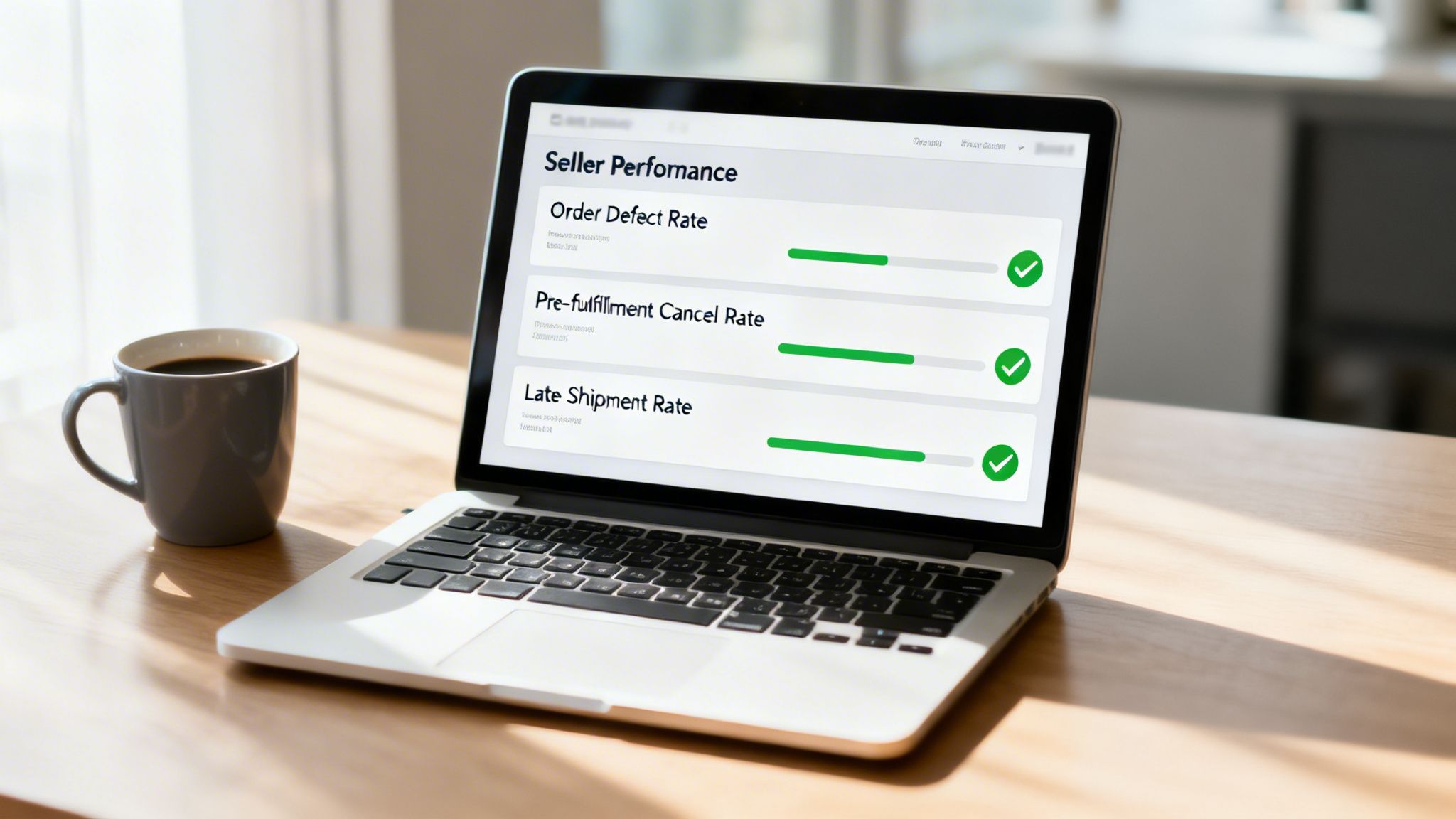
These metrics aren't just friendly suggestions. They are hard targets you absolutely must hit to keep your account in good standing and have any chance at the Buy Box. Let's dig into the most critical ones and talk about how to keep them looking perfect.
Mastering Your Order Defect Rate
Your Order Defect Rate (ODR) is the big one. It's Amazon's primary gauge of customer satisfaction, and the rule is simple: keep it below 1% over any 60-day period. If you let it creep higher, your Buy Box eligibility—and even your entire account—is in jeopardy.
This single percentage is a cocktail of three different issues:
- Negative Feedback Rate: The percentage of your orders that get a thumbs-down from a buyer.
- A-to-z Guarantee Claim Rate: How often a customer files a formal claim because of an issue with the product or delivery.
- Credit Card Chargeback Rate: When a customer goes to their credit card company to dispute the purchase.
Seeing your ODR even approach that 1% mark should set off alarm bells. The best way to keep it down is with relentless, proactive customer service. Don't sit back and wait for a problem to land in your lap. Have polite, professional email templates ready to go for common situations like a shipping delay or a question about the product. A fast, helpful reply can stop a minor annoyance from turning into a dreaded A-to-z claim or a nasty piece of feedback.
Think of your ODR as a direct reflection of your business's health in Amazon's eyes. It shows whether you're creating happy customers or just headaches. Keeping it as close to zero as possible isn't optional; it's a cornerstone of winning the Buy Box.
Avoiding Pre-fulfillment Cancellations and Late Shipments
If you handle your own fulfillment (FBM), two other metrics become your constant companions: the Pre-fulfillment Cancel Rate and the Late Shipment Rate (LSR). These are direct measures of how reliable your operation is.
Your Pre-fulfillment Cancel Rate tracks how many orders you cancel before you ship them, which almost always happens because you ran out of stock. Amazon insists this stay under 2.5%. Canceling an order is one of the worst experiences you can give a buyer, and Amazon hates it.
Then there's your Late Shipment Rate (LSR), which is the percentage of orders you ship after the expected date. This number absolutely has to stay under 4%. Nothing frustrates a customer more than a late package, and the Buy Box algorithm punishes it severely.
Nine times out of ten, the root cause for both of these problems is sloppy inventory management. You can't sell what you don't have, and you can't ship on time if you can't find it. This is where good inventory management software is a non-negotiable. These tools sync your stock levels across channels, stop you from overselling, and give you a heads-up when it's time to reorder. It's an automated safety net, especially for digital nomads who need their business to run smoothly from anywhere.
By building solid systems for customer service and inventory, you're doing more than just protecting your account. You're building the kind of reputation the Buy Box algorithm is designed to find and reward. When your metrics are flawless, you’re proving your offer is the best and safest bet for the customer—and that’s the ultimate competitive advantage.
Applying Strategic Pricing and Inventory Health
Okay, so your account health is solid and you're eligible for the Buy Box. Now for the real dogfight: pricing and inventory.
A lot of sellers think winning the Buy Box means a constant race to the bottom on price. That's a fast track to killing your margins. The real goal is to win it at the highest possible price. This requires a smarter, more dynamic approach than just manually dropping your price by a penny every hour.
That’s where automated repricers become your best friend. Honestly, trying to keep up with competitor price changes across your catalog, even a small one, is a recipe for burnout and missed sales. A good repricing tool automates this, reacting instantly to keep your offer competitive 24/7.
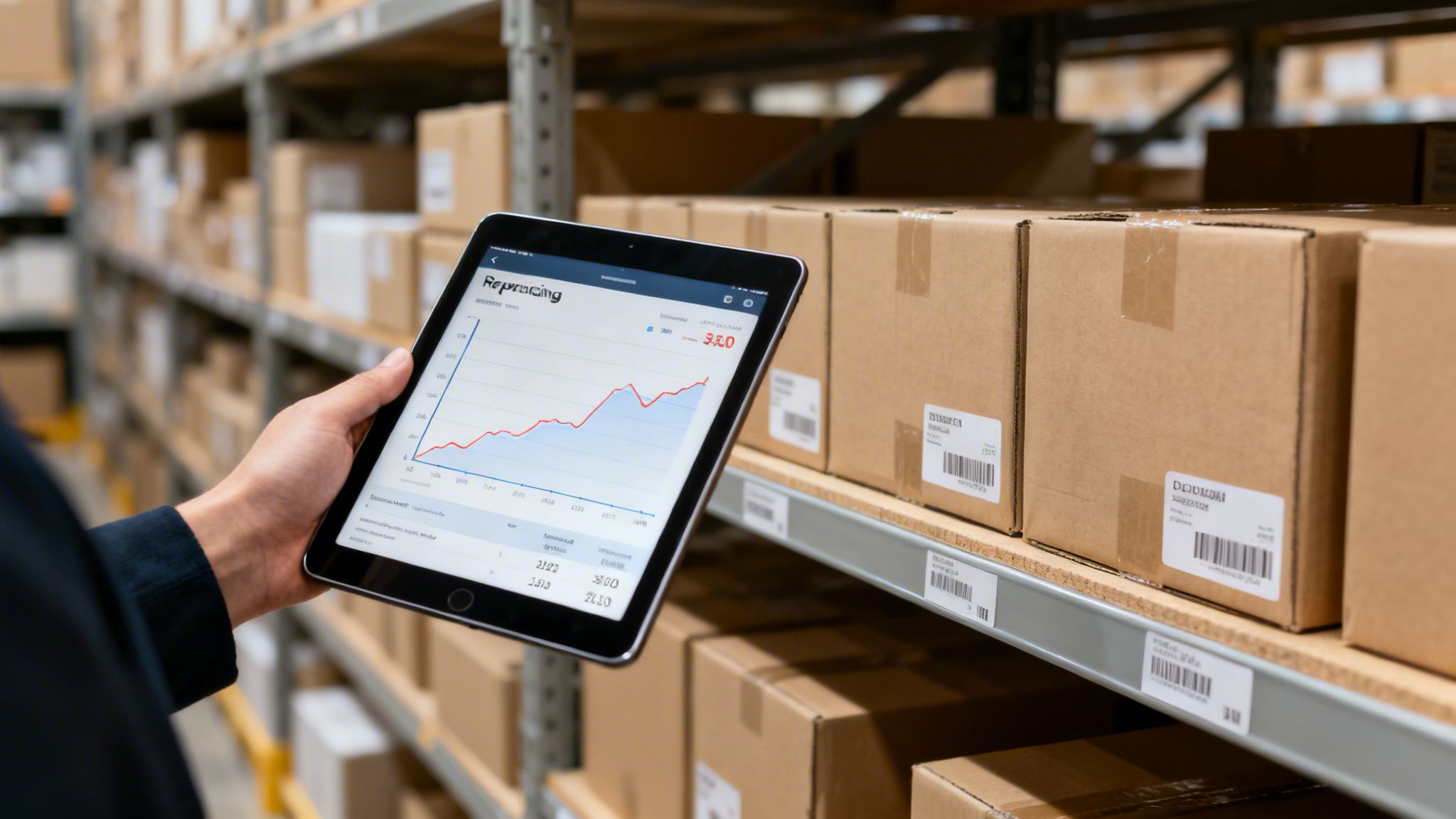
Choosing Your Repricing Weapon: Rule-Based vs. AI
When you start looking at repricers, you'll see two main types. The right one for you really depends on your business, your budget, and how much time you want to spend setting it up.
Choosing between a rule-based or an AI-powered tool can significantly impact your profitability. Here’s a quick breakdown to help you decide.
Rule-Based Repricer vs. AI-Powered Repricer
| Feature | Rule-Based Repricer | AI-Powered Repricer |
|---|---|---|
| Logic | Follows simple "if-then" commands you create (e.g., "Stay $0.01 below the lowest FBA price"). | Uses machine learning to analyze multiple data points (competitor metrics, sales history) to find the optimal price. |
| Best For | Sellers with predictable competition, smaller catalogs, or those on a tight budget. | Sellers in competitive niches, with larger catalogs, or those focused on maximizing profit over just winning the sale. |
| Price Strategy | Can lead to price wars if all competitors use similar rules. | Aims to win the Buy Box at the highest possible price, even if it’s not the lowest overall. |
| Setup | Simpler to configure initially. | Requires more trust in the algorithm but is often more "set it and forget it" after the initial phase. |
While rule-based repricers get the job done, the real money is made with smarter tools. Mastering effective Amazon pricing strategies often means moving to an AI tool that makes profit-driven decisions, not just price-driven ones.
A smart repricer's job isn't just to win the Buy Box, but to reprice up whenever possible. The second a lower-priced competitor sells out, the tool should immediately raise your price to capture maximum margin from the next sale. This is where you make your money.
Don't Forget Inventory Health
Here's a hard truth: the most brilliant pricing strategy in the world is completely useless if you run out of stock.
You can't win the Buy Box if your inventory count is zero—it’s an automatic disqualification. This is why your inventory levels and your pricing strategy are two sides of the same coin. A sudden stockout doesn't just cost you sales; it kills your momentum and tells Amazon you’re unreliable.
Amazon tracks this closely, especially for FBA sellers, through your Inventory Performance Index (IPI) score. This metric, on a scale of 0 to 1,000, shows how well you’re managing your FBA inventory. If your IPI score drops too low, Amazon can hit you with storage limits, crippling your ability to stay in stock and, you guessed it, win the Buy Box. If you're struggling with this, we've got a full playbook on what to do when running low on inventory that can help you steer clear of these issues.
Ultimately, you need to know how you're performing. Your Buy Box win percentage is the key metric here. You can find this in Seller Central, but the 2-day view isn't enough. You should be tracking this over a 30-day period and aiming for a consistent score above 70%.
Your Seller Reputation: The Buy Box Tie-Breaker
So you've matched your competitor's price down to the penny. What happens now? When everything else is equal, Amazon’s algorithm defaults to one thing: trust. It needs to pick the seller most likely to deliver a fantastic customer experience, and it judges this by looking squarely at your seller feedback and shipping track record.
Think of your seller rating as your reputation on the platform. A high rating is a powerful signal to Amazon that you’re reliable and that customers are happy. This reputation is so important that it can sometimes let you win the Buy Box even when your price is a bit higher than a competitor who has shaky metrics. It’s Amazon’s way of rewarding sellers who make their customers happy and protect the brand.
Keeping Your Customer Feedback Score High
You can't just sit back and hope for good reviews. That’s a slow-burn strategy that can backfire fast. All it takes is one or two unhappy customers leaving negative feedback to tank your rating and kick you out of Buy Box contention.
A much better way to handle this is by using an automated email system to request feedback after an order has been delivered. Just make sure whatever tool you use is 100% compliant with Amazon's rules. When done right, this can be a game-changer for building a buffer of positive reviews.
- Nail the timing. Don't ask for a review the second the package arrives. Give your customer a few days to actually open it and use the product. The experience will still be fresh, but they'll have something real to say.
- Keep the ask simple and neutral. A straightforward message works best. Something like, "Thanks for your order! We'd love to hear how your experience was," is perfect. Never, ever offer anything in exchange for a good review.
- Jump on negative feedback immediately. If a bad review comes in, treat it like an emergency. Contact the customer right away and do what it takes to solve their problem. Once they're happy, you can politely ask if they’d consider updating their feedback.
Nailing Your Shipping Performance (Especially for FBM)
If you're handling your own fulfillment (FBM), Amazon puts your shipping performance under a microscope. Delivery speed and reliability are everything to Amazon, so they track these metrics relentlessly. To even be in the running for the Buy Box, you have to hit their targets.
There are two metrics that matter most here:
- Valid Tracking Rate (VTR): This is simply the percentage of your orders that have a valid tracking number. Amazon’s requirement is strict: you must stay above 95%. Anything lower looks unprofessional and hurts customer trust.
- On-Time Delivery Rate (OTDR): This measures how many of your shipments arrive by the promised delivery date. You need to keep your OTDR above 97%. Late packages are one of the biggest drivers of customer complaints.
If you let these numbers slip, your offers will become practically invisible to the Buy Box algorithm. If you're shipping your own products, you have to stay on top of this, especially during the chaotic holiday season. It’s critical to avoid these shipping mistakes during Q4 if you want to protect your account health.
The FBA Shortcut: This is where FBA shines. When you use Fulfillment by Amazon, every single shipping-related metric is automatically perfected for you. Your VTR and OTDR are effectively 100%, guaranteed. This takes a massive operational headache off your plate and gives the Buy Box algorithm exactly the kind of flawless performance it rewards.
The data doesn't lie. FBA sellers consistently dominate, winning the Buy Box 75-85% of the time compared to just 30-50% for even the fastest FBM sellers. This is largely because FBA gives you automatic Prime eligibility and leverages Amazon's world-class logistics. Back in 2019, FBA itself posted a 98.9% On-Time Delivery Rate (OTDR), instantly satisfying nearly 40% of the 13 Buy Box factors for sellers. You can dig into more Buy Box statistics on repricer.com. It’s why FBA continues to be the single most effective weapon for winning the Amazon Buy Box again and again.
Common Questions About Winning the Buy Box
No matter how much you know about the Buy Box, there are always a few head-scratching moments that pop up. Let's dig into some of the most common questions I hear from sellers and get you the answers you need to troubleshoot those confusing situations.
Why Am I Losing the Buy Box Even Though I Have the Lowest Price?
This is probably the single most maddening part of selling on Amazon. You've dropped your price, you're the cheapest offer on the listing, and you still don't have the Buy Box. What gives?
It almost always comes down to this: Amazon's goal isn't to show the cheapest price; it's to deliver the best possible experience for its customers. The algorithm is constantly weighing your offer against your competitors' based on a whole host of factors beyond price.
If a competitor has stronger seller metrics—maybe they use FBA while you use FBM, or their feedback rating is a few points higher—Amazon sees their offer as a safer, more reliable bet for the buyer. They can, and often will, win the Buy Box at a slightly higher price because they've proven they can deliver.
How Can a New Seller Actually Win the Buy Box?
Breaking through as a new seller can feel impossible. You have no sales history and zero feedback, which means to Amazon's algorithm, you're a complete unknown.
The key is to build a positive reputation, fast. Here's what you need to do:
- Sign up for FBA from day one. This is your shortcut to credibility. It immediately gives you Prime eligibility and perfect shipping metrics, which are massive factors in the Buy Box equation.
- Price to win, not just to profit (at first). You might have to sacrifice some margin on your initial sales. Think of it as a marketing cost to prove you're a reliable seller who ships a quality product on time.
- Get proactive with feedback. Use an Amazon-compliant email tool to start requesting reviews from your very first order. Building that seller rating is crucial.
This initial sprint is all about creating a track record. Once the algorithm sees you can successfully fulfill orders and keep customers happy, it will start trusting you with that coveted Buy Box placement.
For nomads, FBA is a game-changer for creating a hands-off operation. You send your inventory to Amazon, and they handle the rest, letting you focus on marketing or sourcing from anywhere in the world. But don't sleep on reviews; high-volume positive feedback is a powerful trust signal that can help you win the Buy Box even when you're not the lowest price. You can find more on this in these insights on how the Amazon Buy Box works.
Can I Win the Buy Box Against Amazon Retail?
Going head-to-head with Amazon itself is the final boss battle of selling. Amazon gives its own retail offers a huge, built-in advantage. It’s tough, but not impossible to win.
Your best shot is when Amazon runs out of stock. This happens more often than you'd think. If you have your product sitting in an FBA warehouse when Amazon's own supply runs dry, you can swoop in and capture the Buy Box until they restock.
Set up alerts to notify you when Amazon goes out of stock on your shared listings. That's your window of opportunity to jump on sales you'd otherwise never get.
Ready to turn your e-commerce grind into a scalable, location-independent business? The Selling From The Beach newsletter is your bi-weekly dose of actionable advice on Amazon, Shopify, marketing, and the digital nomad lifestyle. Subscribe today at https://sellingfromthebeach.com.